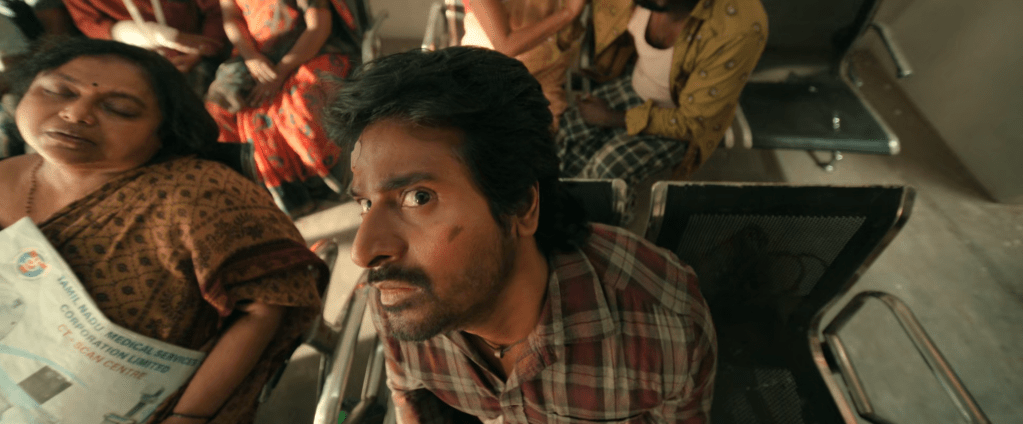
Two men. Two voices. One driven by fear, the other by frustration. Both resisting. Both being led to a place they refuse to go—who reached where?
Our protagonist in this film is a coward—one who avoids confrontation at all costs, even when he is the victim or when his mother and sister face difficult situations, including harassment. Apart from his skill of being a coward 24/7, he is a comic artist, sketching for a daily magazine, struggling to find a permanent job. He needs to feed himself and two more mouths at home.
Sathya (played by Sivakarthikeyan) creates a fictional world for newspaper column where his sketched protagonist is everything he is not—a great warrior, a fearless leader who stands against the evil, fights for his own people, and embraces the courage to die for his land and for his community. An alter ego of Sathya emerges naturally and unintentionally as he sketches—only for daily wages. A reflection of the man he never wishes and wants to be, yet he showcases this better version of himself to the world through art. Only his love interest notices it and motivates him to become one. But did he become one?
Later, our cowardly protagonist is forced to confront his fate after an accident—when he decides to take his own life; he begins hearing a strange voice, the voice saves him from suicide, starts whispering instructions about the near future only in Sathya’s ears.
Fear consumes Sathya. Why him? Why this voice? He can’t stop questioning it. He just wants the voice to stop. But then, the voice tells him something terrifying—he is destined to sacrifice his life for his people. Now, Sathya doesn’t just want the voice to stop; he wants to survive.
A voice that saved him from death can lead him to die?
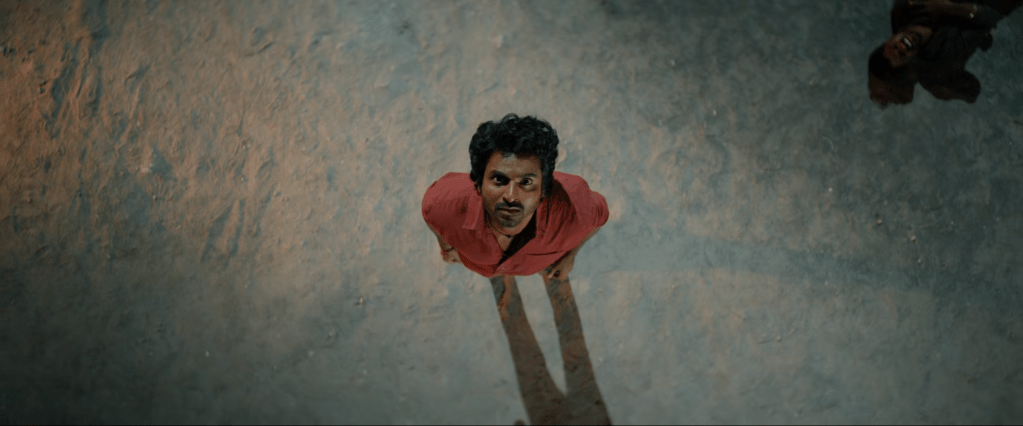
A still from “Maaveeran” (2023)
The most fascinating detail in this story is that, just like the protagonist, the antagonist hears a voice too. Unlike Sathya, the villain knows who the voice belongs to and where it comes from—yet at some point, it becomes overwhelming for him. The one thing the hero and the villain have in common is neither fully understands the advantage the voice holds.
The hero’s battle with the voice occupies most of the film’s runtime, intertwined with a subplot of political corruption—housing developments forcing people out of their native lands, relocating them to poorly built high-rises, only to reveal that the structures are as fragile as a child’s Lego tower.
But the question remains: Is Sathya truly a warrior if he simply follows the voice’s commands, even if he gives his life for people he once never cared for? Or is real strength found in questioning it, in fighting against it until he understands why it led him here? Only when he breaks free from his selfishness, his cowardice, his unwillingness to stand for something greater, does he become what his mother always wished for—a brave young man. Only then does he prove to his sister that he can fight for her, protect her—not just for them, but for their community, for those who have no one else to fight for them.
Before the third act, both the protagonist and the antagonist lose their voices. One can’t bear the continuous humiliation of being stripped of his power in front of his employees. The other? Sathya still wants to stay selfish, still wants to care about no one but himself. And yet, despite their resistance, they both lose their hearing. The voices fall silent.
Both reach a state of neutrality—now fully accountable for their actions. Our hero suddenly realizes the impact of not listening to the voice, and this void makes him look closer at where he stands, understanding that the ship is about to sink. The antagonist, now free of commands and control, acts erratically, making foolish decisions that lead to his downfall sooner than expected. Sathya’s realisation may be cliché, but it’s unavoidable for a ‘rise of a hero’ story.
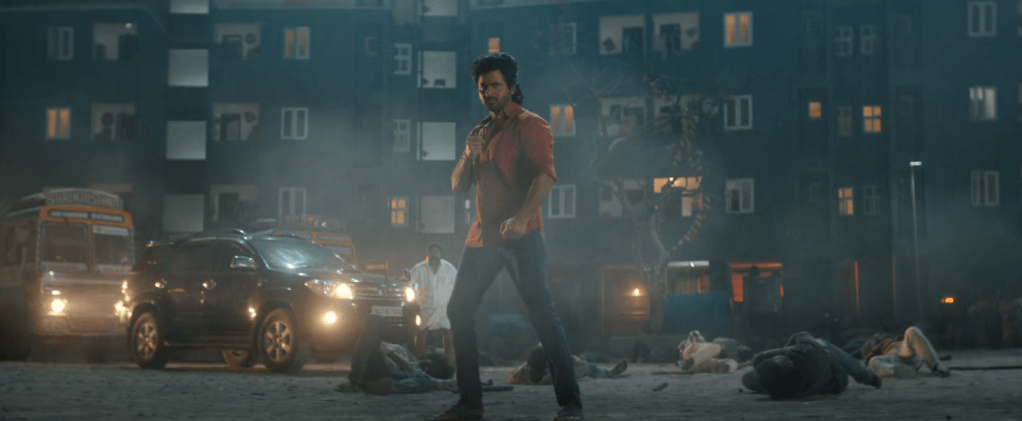
Another still from “Maaveeran” (2023)
Sathya overcomes his fear, his shell. He stands up for his people. And he almost dies saving them. In the end, he becomes a great warrior—but not because of the voice. Because of himself. The voice has served its purpose. Sathya now understands: he may not have been chosen one, but he has found his purpose. He was always a warrior, buried under layers of fear, voluntarily blinding himself to the corruption around him. He just needed to see it and the voice aided him to muster up his courage.
In the end, Sathya saves his people by nearly dying, like what the voice predicted—but he hears nothing, not his mother, not his people, not anything. He loses his hearing—except the voice. He and the voice become a single entity. Beyond its subtlety, this is a perfect setup for a Marvel Studios-esque superhero origin story.

Another still from “Maaveeran” (2023)
Apart from the underwhelming female lead, who only exists to serve a romantic song, and the subjective comedy track around the faulty housing project, the soundtrack and cinematography stand taller than those poorly constructed government buildings meant for the poor.
The writer of the film is a National Award winner for his debut feature—a sharp, satirical socio-political comedy-drama. In his second film Maaveeran, he doesn’t falter in creativity. Perhaps the box office numbers and general reviews didn’t match the expectations, but for a mainstream film, this is a brilliant piece of work that received only an average response—too subtle, too intelligent to be fully appreciated by a broad audience. Few online communities keep appreciating this film—maybe we still need to wait for this to become a classic or maybe not.
You don’t always need complex screenplays packed with unimaginable twists placed at unpredictable moments in a known film’s runtime. A well-crafted, entertaining, old-school cat-and-mouse, hero vs. villain, or rise-of-a-hero story can still be brilliant in the mainstream space.
 Incomplete Reviews