Tag: film

  • The Second Act (2024) Review: An Inception-Level Parody of AI, Cinema, and Itself

    The Second Act (2024) Review: An Inception-Level Parody of AI, Cinema, and Itself

    Rating 3/5

    A movie shows movie stars trying to be a part of a movie — through a movie.
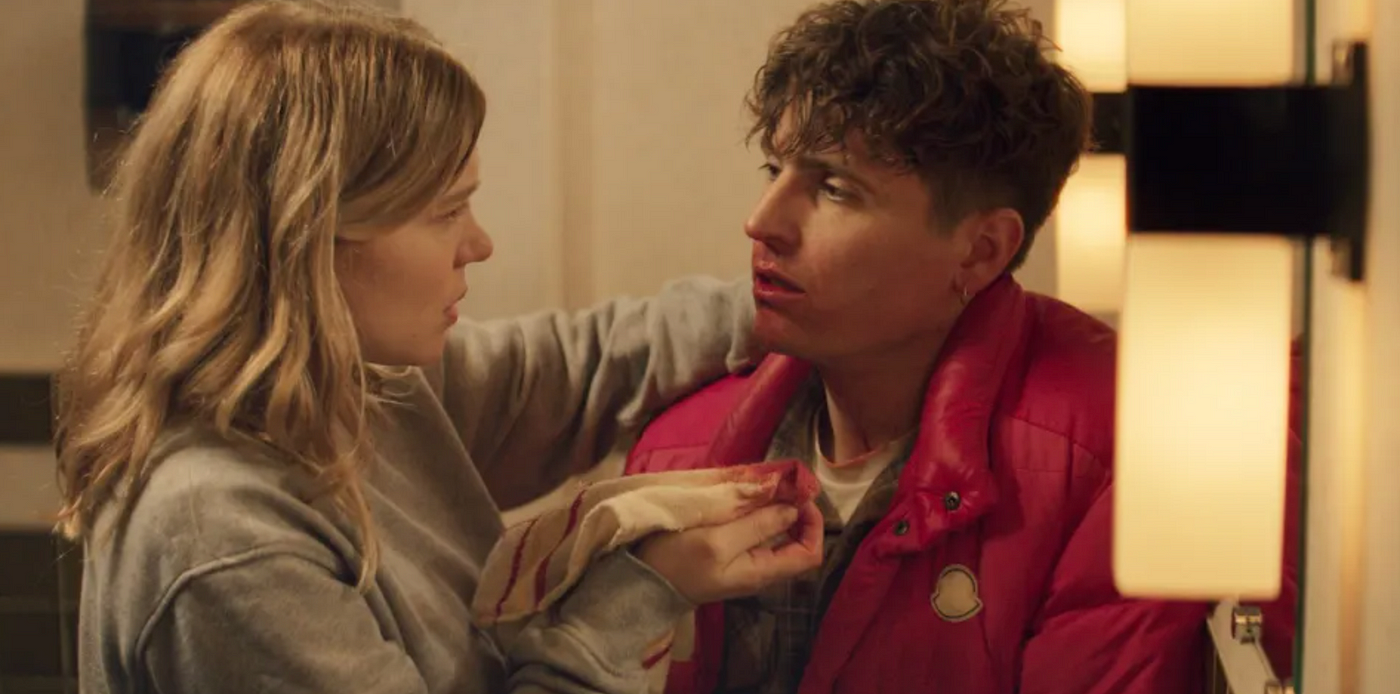
    Léa Seydoux (left) as Florence and Raphaël Quenard (right) as Willy from “The Second Act (2024)”

    Quentin Dupieux, known for his signature brand of quirky, surreal humour, minimalist casts, and theatrical staging, returns with another delightfully absurd meta-film. In “The Second Act” (French titled: Le Deuxième Acte), Quentin Dupieux weaves two layered narratives — one about actors making a film, and the other exploring the off-screen lives of those same actors, who are also characters within the film itself.

    The plot is deliberately layered and chaotic — probably on purpose. Two main storylines unfold simultaneously, folded into each other like a cinematic mille-feuille. It’s the kind of setup were keeping track of what’s “real” and what’s “in-film” is both part of the confusion and the fun.

    Léa Seydoux plays an actress named Florence, who, within the film, is playing a character in a movie directed by Artificial Intelligence. Her in-film character is a woman hopelessly in love with a “man”, played by David; Florence, struggles to keep her acting career. David, also an actor within the AI-generated movie, is played by Louis Garrel. Louis carries both calm and composed yet always having a fear of being politically correct roles. Florence’s character is obsessive to the point of emotional suffocation — checking in on her “boyfriend” every 30 minutes. But the “man” is not attracted to her, doesn’t know how to confront her directly. So, he recruits his friend to intervene — played by Willy (who is played by Raphaël Quenard). The friend character is confused: why would his friend push away someone so in love with him? His skepticism builds into curiosity, and eventually, after some back and forth, he agrees to meet the girl.

    Meanwhile, the girl brings along her “father” — a talkative banker, played by Guillaume. But Guillaume is also a fictional actor inside the larger narrative, played by Vincent Lindon. And mid-shoot, Guillaume gets offered a role in a Paul Thomas Anderson film — creating yet another meta-layer within the story. So, now we’re watching actors playing actors playing characters in a film directed by AI, with one of them being poached for another movie, all within a film.

    Louis Garrel as David from “The Second Act (2024)”

    What happens when all four characters meet? What happens when the actors playing these characters start bleeding into their roles, and their roles bleed into them? How the actors suffer from their own acting life and put up with other actors but aiming to finish playing their characters. That is all about of “The Second Act”.

    Each of the lead actors takes on two personas, and they switch between them seamlessly and convincingly. The entire story takes place over the course of a single day, and within just a few hours. The costumes and makeup stay the same, the personalities shift quickly. The transitions aren’t there to trick the viewer or showcase cleverness — they’re there to highlight process. In a way, it feels almost like a documentary on performance.

    Unlike most modern satires that lean into jittery handheld camera work and snap zooms (like from “In the Loop” or “Succession”), Dupieux stays true to his style. He uses clean, composed shots — often dolly-based — that give a strangely polished clarity to the chaos unfolding onscreen. It adds to the surrealism, creating the feeling that everything is controlled, even when what we’re watching feels entirely unhinged.

    It may feel a bit confusing at first — since the first act only unfolds during the final act of “The Second Act”. The film opens with a waiter unlocking a café called “Le Deuxième Acte”, setting the stage in a literal sense. The location, like the script, is minimal yet loaded. The conversation-heavy satire unfolds within that confined space, as we’re gradually pulled into the absurdities of both the story and the filmmaking process itself. The dialogue is dense and layered — not necessarily philosophical or logical, but more about exposing the emotional chaos of each character — in a Quentin Dupieux’s humour.
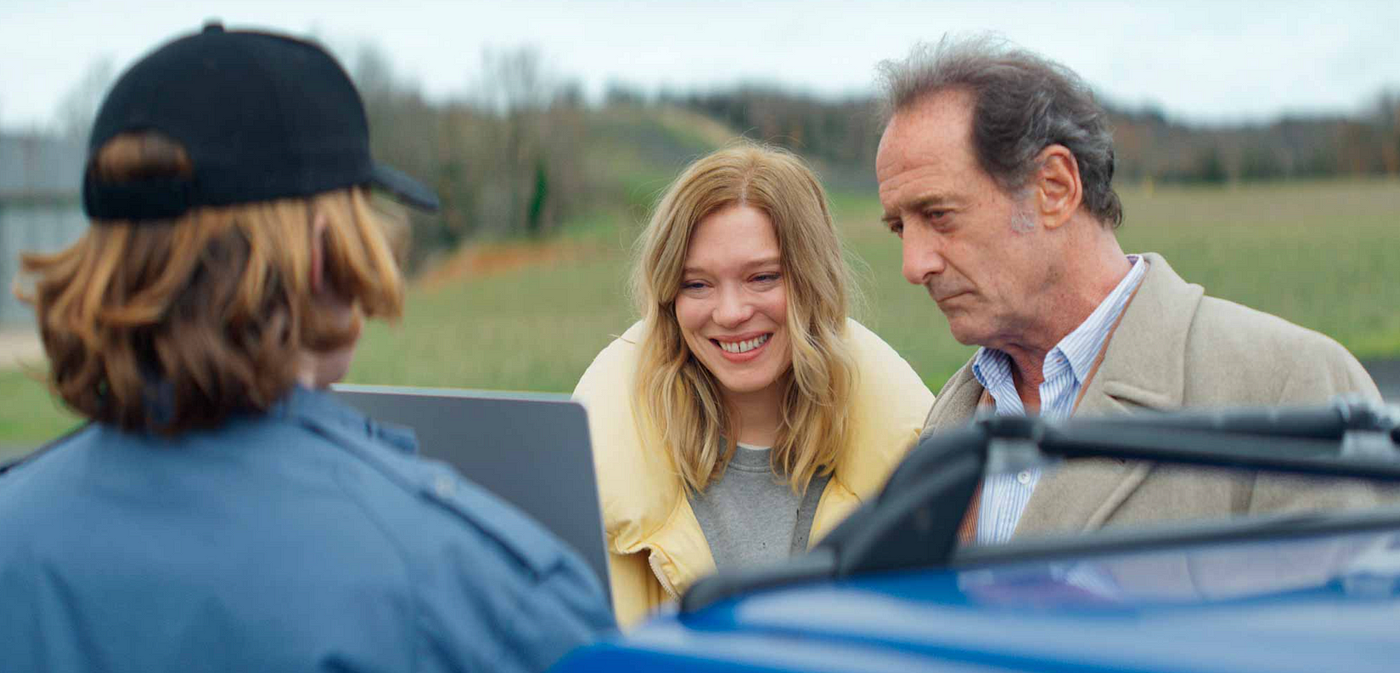
    Léa Seydoux (left) as Florence and Vincent Lindon (right) as Guillaume from “The Second Act (2024)”

    What’s more fascinating is how different each actor is from the character they’re playing within the film. For instance, Guillaume, the character, is homophobic. But Vincent Lindon’s in-film actor reveals that he’s gay — adding tension between performance and identity, and again showing how messy and performative “truth” can be when filtered through art.

    The film shows that AI has the potential in generating a film on its own, hires people, give the instructions and make decisions to cut actor’s fees because of their inabilities and faults. We are not too far away to this idea with rapid evolution of Generative AI (GenAI), Large Language Models (LLMs) and Agentic AIs. One of the most powerful scenes is subtle but chilling. The AI director refuses to accept feedback from the actors — no matter how sincere or insightful; whether the suggestions were good or bad, whether it’s a compliment or a doubt, the AI simply ignores it. Once the system has authority, it shuts out human emotion entirely. That’s when the satire hits hardest — not through slapstick or one-liners, but through a quiet reminder of what the industry might look like if AI becomes the ultimate auteur.

    “The Second Act” is messy, brilliant, confusing, and strangely prophetic. It may not make you laugh out loud, but it will absolutely make you think twice about what comes after the first act. The humour maybe dry, self-aware, and always one step ahead. And while it might not be for everyone, it is unmistakably a Quentin Dupieux experience.
  • The Return (2024) Review: A Minimalistic Adaptation of a Mythical Journey

    The Return (2024) Review: A Minimalistic Adaptation of a Mythical Journey

    Rating: 3/5

    This adaptation is more of a meditative experience—a grounded, realistic take on Odysseus’s return from Troy, far removed from the spectacle and fantasy. It’s not a film that seeks to impress with action or grandeur but rather reflects on time, loss, and the fragility of homecoming.

    Directed by Uberto Pasolini, and starring Ralph Fiennes and Juliette Binoche as the king and queen of Ithaca, “The Return” doesn’t aim to surprise with plot twists. After all, this is a story that has been told countless times on the big screen and stage. Maybe that is exactly the challenge here—how do you retell a mythical story that everyone knows and still make it feel fresh and meaningful? Pasolini’s answer is to strip it back. No grand entrances. No gods. No monsters. Just man, memory, and the weight of time.

    The story begins after the Greeks have won the Trojan War. Odysseus returns home to Ithaca decades later, unrecognizable and aged, both physically and spiritually. He is still a soldier, but no longer the man who left. He is a man who has lost and endured, and now must find his purpose again. For most of the island, he’s long dead, a ghost beneath the waves. But his wife, Penelope, has been fighting her own silent war for years, even after the war in Troy ended—a war of patience, loneliness, and quiet resilience. She has been holding the kingdom together while surrounded by men who want to take what little remains.

    Everyone around her, including her own son, urges her to move on and choose a new king to marry from among the Suitors—men who circle her like vultures, each with their own ambition and agenda. They are less interested in love and more concerned with legacy, power, and on Penelope. And yet, she waits. Not because she’s certain Odysseus is alive, but because her faith is stronger than logic. She waits, hoping, resisting.

    “The Return” is about what happens when Odysseus finally reappears. How does he confront a home that is no longer his in the way he remembers? A home in ruins, emotionally and morally. Can he reclaim not just his throne, but the trust of his people and the bond with his wife and son, who have all changed in his absence?

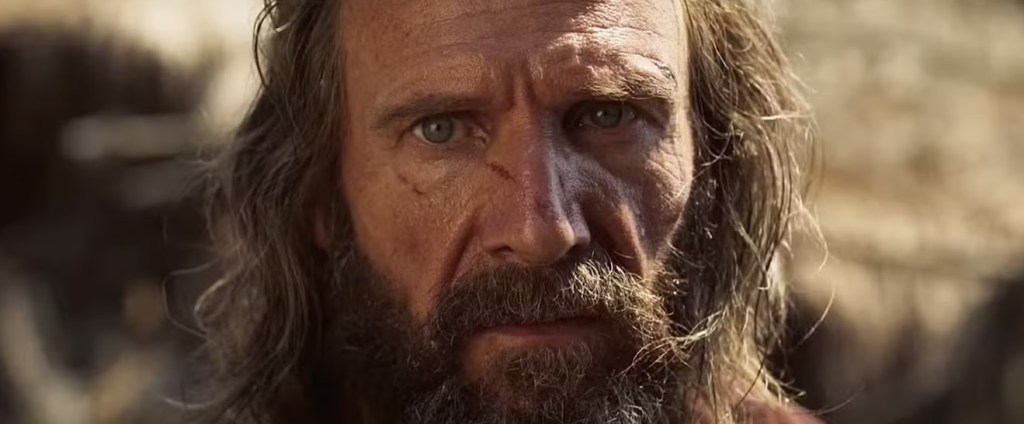
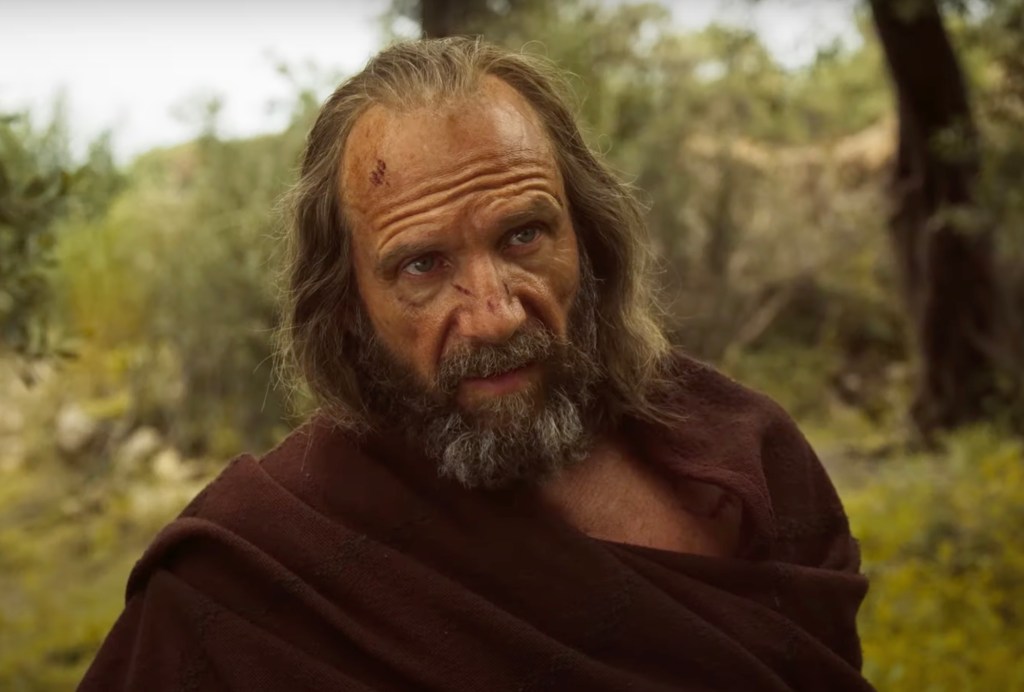
    Ralph Fiennes and Juliette Binoche carry the film with quiet intensity, making us feel as though we’re watching the real Odysseus and Penelope. They settle effortlessly into their roles. Ralph, with his solid build for his age and weathered expression, perfectly embodies an older, war-worn Odysseus. It’s a tailor-made role that allows his subtlety to shine without needing grand gestures or loud declarations. Juliette, on the other hand, matches him in restraint. Her eyes speak volumes, even though her lines are few. There’s a quiet power in her presence, and she communicates so much with silence. Another standout is Marwan Kenzari as Antinous. His performance is equally nuanced, and he delivers with the same controlled strength as the English Patient pair, adding yet another layer of subtlety to the film.

    One of the most striking aspects of the film is the camera work. Pasolini chooses to shoot characters up close—tight frames on weathered faces, tired eyes, and restrained emotions. It’s an unusual choice for a historical drama, where the tendency is to lean into wide, sweeping visuals. Here, the camera doesn’t care about grandeur—it focuses on truth, discomfort, and intimacy. These characters aren’t ancient gods or statues—they’re people worn down by time, grief, and loss. Still, the emotions are not overplayed. They remain grounded, and for some, maybe too grounded. That may be appealing to some, appalling to others.

    The film is remarkably minimalistic. No CGI monsters. No elaborate fantasy elements. Just real locations, real textures, and a rawness that strips the myth down to its human core. The absence of spectacle is what makes the film unique. The minimalism in “The Return” comes through in every aspect of its production—fewer characters, limited set-pieces, and authentic settings that ground the story in something tangible. The entire film carries the pacing and aspect ratio of a neatly crafted high-budget Indie film.

    While this grounded approach is admirable and adds authenticity, the emotional weight doesn’t always translate fully to the audience. That’s mostly due to the very same groundedness. Key moments—like when the old nurse realises the king has finally returned, or when the queen instructs her son to hand the bow to his father—are shot with poetic care. The lighting is soft, the staging is quiet, and the emotions are present, but they pass by too quickly. These are scenes that should have hit harder, that carried deep narrative weight, but they feel like gentle ripples instead of waves. Films of this kind often risk becoming too quiet, too introspective, and can feel less accessible to broader audiences. Yet, despite this, “The Return” still manages to hold attention—even if only at a low, steady throttle.

    The score is subdued, and rightly so. This isn’t a sweeping, cinematic adventure. The music simply supports the emotions when needed, stepping aside when the atmosphere and the performances speak louder. It appears when it needs to, and disappears when it doesn’t—never overstaying its welcome or trying to manipulate the audience. Maybe Christopher Nolan’s upcoming Odyssey will offer a more mainstream, high-concept version of the same myth, packed with spectacle and wide appeal. But “The Return” gives us something else. It offers a slow, patient, and reflective look at a man trying to return—not just to a place, but to a version of himself that may no longer exist.

    This isn’t for everyone. It’s not designed to be. But for those who appreciate quiet, grounded cinema that respects its source material while daring to reimagine it through a more human lens, “The Return” is a deeply rewarding experience.

  • Maaveeran (2023): Brilliant writing in a recent Tamil mainstream

    Maaveeran (2023): Brilliant writing in a recent Tamil mainstream

    Two men. Two voices. One driven by fear, the other by frustration. Both resisting. Both being led to a place they refuse to go—who reached where?

    Our protagonist in this film is a coward—one who avoids confrontation at all costs, even when he is the victim or when his mother and sister face difficult situations, including harassment. Apart from his skill of being a coward 24/7, he is a comic artist, sketching for a daily magazine, struggling to find a permanent job. He needs to feed himself and two more mouths at home.

    Sathya (played by Sivakarthikeyan) creates a fictional world for newspaper column where his sketched protagonist is everything he is not—a great warrior, a fearless leader who stands against the evil, fights for his own people, and embraces the courage to die for his land and for his community. An alter ego of Sathya emerges naturally and unintentionally as he sketches—only for daily wages. A reflection of the man he never wishes and wants to be, yet he showcases this better version of himself to the world through art. Only his love interest notices it and motivates him to become one. But did he become one?

    Later, our cowardly protagonist is forced to confront his fate after an accident—when he decides to take his own life; he begins hearing a strange voice, the voice saves him from suicide, starts whispering instructions about the near future only in Sathya’s ears.

    Fear consumes Sathya. Why him? Why this voice? He can’t stop questioning it. He just wants the voice to stop. But then, the voice tells him something terrifying—he is destined to sacrifice his life for his people. Now, Sathya doesn’t just want the voice to stop; he wants to survive.

    A voice that saved him from death can lead him to die?

    Watch “Maaveeran” in Prime

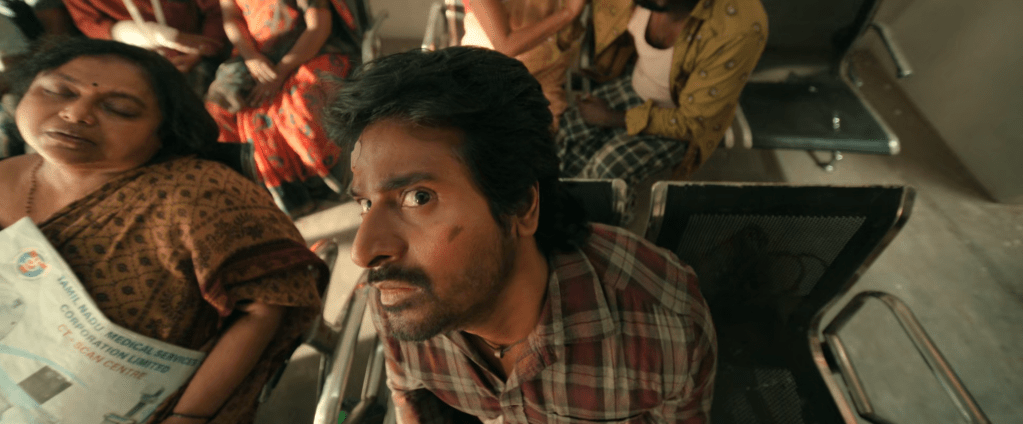
    A still from “Maaveeran” (2023)

    The most fascinating detail in this story is that, just like the protagonist, the antagonist hears a voice too. Unlike Sathya, the villain knows who the voice belongs to and where it comes from—yet at some point, it becomes overwhelming for him. The one thing the hero and the villain have in common is neither fully understands the advantage the voice holds.

    The hero’s battle with the voice occupies most of the film’s runtime, intertwined with a subplot of political corruption—housing developments forcing people out of their native lands, relocating them to poorly built high-rises, only to reveal that the structures are as fragile as a child’s Lego tower.

    But the question remains: Is Sathya truly a warrior if he simply follows the voice’s commands, even if he gives his life for people he once never cared for? Or is real strength found in questioning it, in fighting against it until he understands why it led him here? Only when he breaks free from his selfishness, his cowardice, his unwillingness to stand for something greater, does he become what his mother always wished for—a brave young man. Only then does he prove to his sister that he can fight for her, protect her—not just for them, but for their community, for those who have no one else to fight for them.

    Before the third act, both the protagonist and the antagonist lose their voices. One can’t bear the continuous humiliation of being stripped of his power in front of his employees. The other? Sathya still wants to stay selfish, still wants to care about no one but himself. And yet, despite their resistance, they both lose their hearing. The voices fall silent.

    Both reach a state of neutrality—now fully accountable for their actions. Our hero suddenly realizes the impact of not listening to the voice, and this void makes him look closer at where he stands, understanding that the ship is about to sink. The antagonist, now free of commands and control, acts erratically, making foolish decisions that lead to his downfall sooner than expected. Sathya’s realisation may be cliché, but it’s unavoidable for a ‘rise of a hero’ story.

    Watch “Maaveeran” in Prime

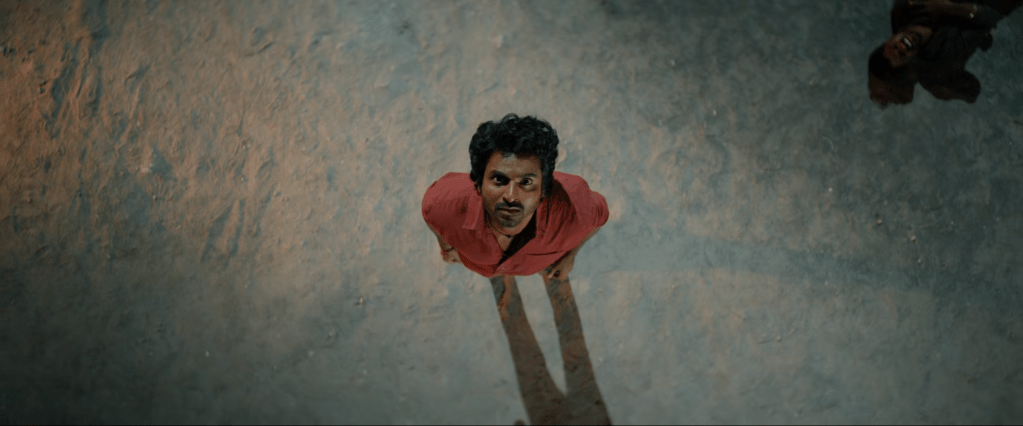
    Another still from “Maaveeran” (2023)

    Sathya overcomes his fear, his shell. He stands up for his people. And he almost dies saving them. In the end, he becomes a great warrior—but not because of the voice. Because of himself. The voice has served its purpose. Sathya now understands: he may not have been chosen one, but he has found his purpose. He was always a warrior, buried under layers of fear, voluntarily blinding himself to the corruption around him. He just needed to see it and the voice aided him to muster up his courage.

    In the end, Sathya saves his people by nearly dying, like what the voice predicted—but he hears nothing, not his mother, not his people, not anything. He loses his hearing—except the voice. He and the voice become a single entity. Beyond its subtlety, this is a perfect setup for a Marvel Studios-esque superhero origin story.

    Watch “Maaveeran” in Prime

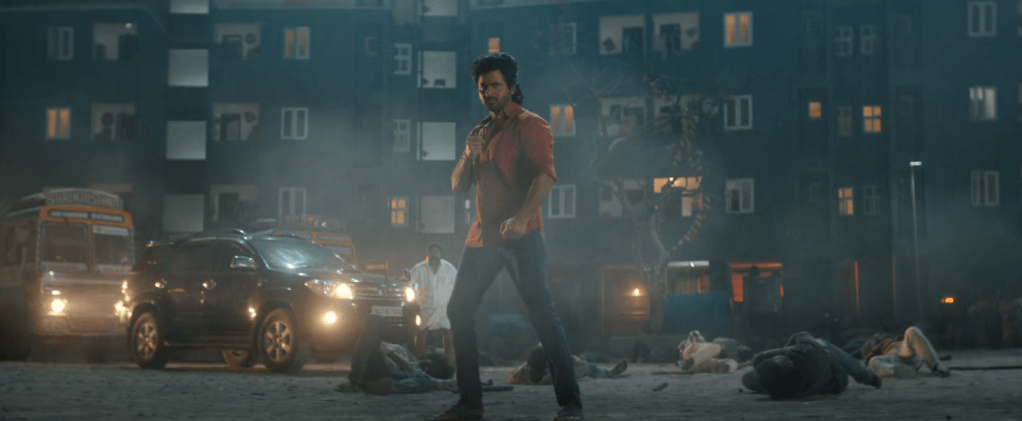
    Another still from “Maaveeran” (2023)

    Apart from the underwhelming female lead, who only exists to serve a romantic song, and the subjective comedy track around the faulty housing project, the soundtrack and cinematography stand taller than those poorly constructed government buildings meant for the poor.

    The writer of the film is a National Award winner for his debut feature—a sharp, satirical socio-political comedy-drama. In his second film Maaveeran, he doesn’t falter in creativity. Perhaps the box office numbers and general reviews didn’t match the expectations, but for a mainstream film, this is a brilliant piece of work that received only an average response—too subtle, too intelligent to be fully appreciated by a broad audience. Few online communities keep appreciating this film—maybe we still need to wait for this to become a classic or maybe not.

    You don’t always need complex screenplays packed with unimaginable twists placed at unpredictable moments in a known film’s runtime. A well-crafted, entertaining, old-school cat-and-mouse, hero vs. villain, or rise-of-a-hero story can still be brilliant in the mainstream space.

    Watch “Maaveeran” in Prime